
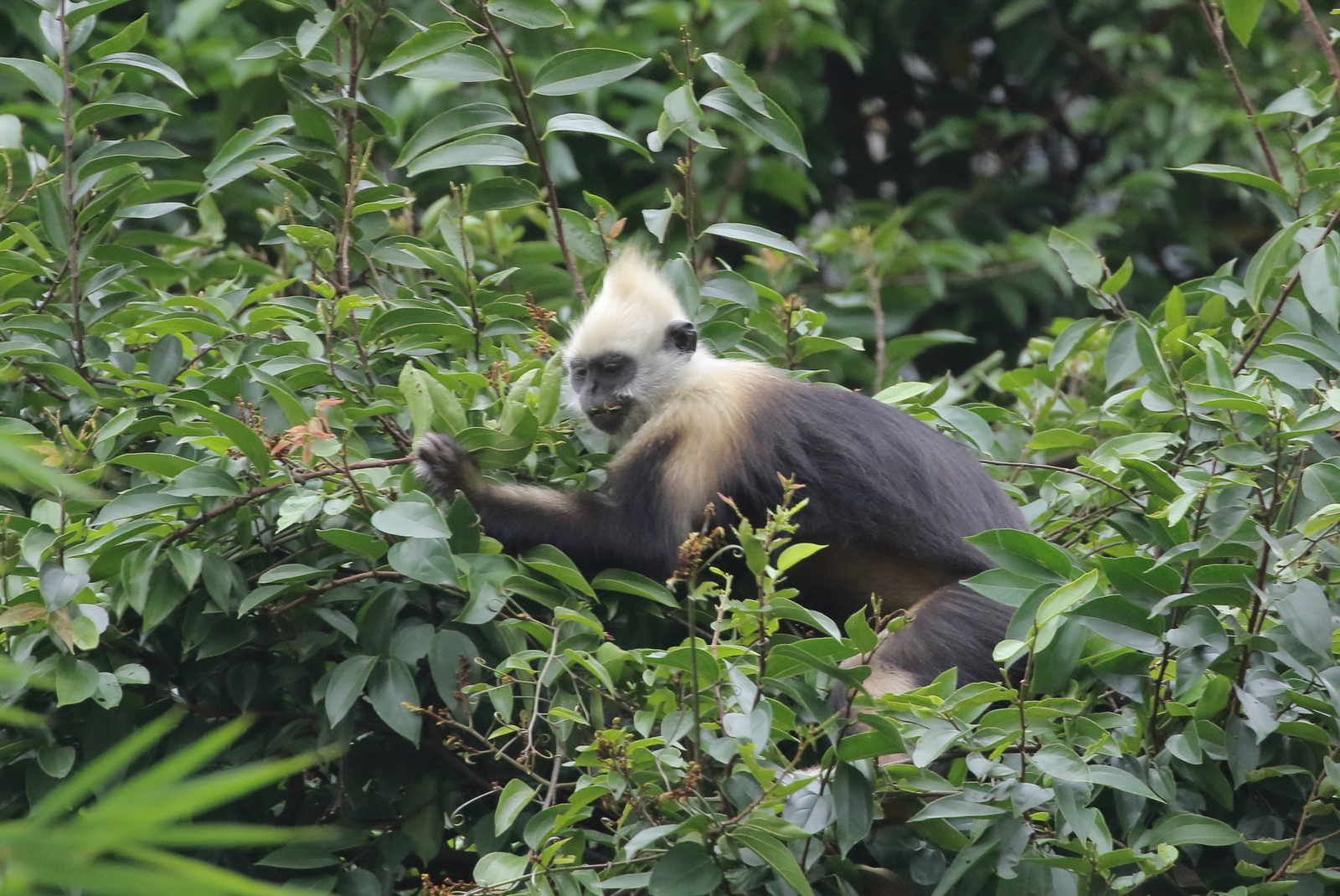
Rarer than the giant panda and nearly invisible in the cliffs it calls home — China’s white-headed langur has quietly staged one of conservation’s most remarkable comebacks.
Deep in the karst mountains of Guangxi, southern China, a small black monkey with a startlingly white head peers down from a limestone cliff. It moves like water across rock — nimble, silent, almost ghostly. The locals call it the “stone mountain elf.” Scientists call it one of the most endangered primates on Earth. Until recently, both groups feared it might disappear entirely.
This week, we learned that the white-headed langur is no longer on the immediate brink of extinction. From just over 300 individuals in the 1980s, the population has now surpassed 1,400, spread across 130 social groups in the Guangxi Chongzuo White-headed Langur National Nature Reserve. That is not luck. It is the result of decades of stubborn conservation work — and, most recently, artificial intelligence that is quietly transforming how we watch over the wild.
Why Was It So Endangered in the First Place?
The white-headed langur exists nowhere else on Earth but a narrow band of karst limestone terrain in Chongzuo, Guangxi. That extreme geographic specificity has always been its greatest vulnerability. The same jagged, cave-riddled cliffs that shelter the langur also attracted quarrying, agriculture, and human settlement — and as those pressures mounted through the 20th century, the langur’s habitat fragmented into isolated pockets, cutting off groups from one another and shrinking genetic diversity. Hunting compounded the crisis. By the 1980s, the species had collapsed to a few hundred individuals — arguably rarer than the giant panda, but without any of the panda’s global celebrity.
How the AI System Actually Works
The karst terrain that makes Guangxi so dramatic also makes traditional wildlife monitoring a nightmare. Rangers can’t easily patrol sheer cliff faces, and manually reviewing hours of footage is slow and expensive. So the reserve partnered with Huawei to build something smarter: more than 20 camera stations mounted directly onto the cliff faces, feeding real-time footage into an AI platform that automatically tags and logs every langur appearance — where it was, what it was doing, when. Think of it like facial recognition, but for monkey behaviour. To date, the system has logged over 37,200 individual detections, building a continuously updated picture of how each social group moves and whether their numbers are changing. That data flows into a dashboard that helps reserve managers decide where to restore habitat, where to build water points, and where ecological corridors are most urgently needed.
The AI is only one thread though. The reserve has also restored nearly 80 hectares of degraded land, built 18 dedicated water points, and constructed two ecological corridors — physical green bridges allowing isolated groups to reconnect and interbreed. New protective legislation gives rangers legal teeth against poaching and development. The entire ecosystem is responding: researchers recently recorded a protected plant species inside the reserve for the first time in living memory.
The stone mountain elf is not saved yet — it remains Critically Endangered. But for the first time in decades, the trend line is pointing firmly upward. In the limestone karst of Guangxi, 1,400 white heads peer down from the cliffs — and a small army of cameras, algorithms, and dedicated conservationists is making sure they stay there.
Leave a Reply