
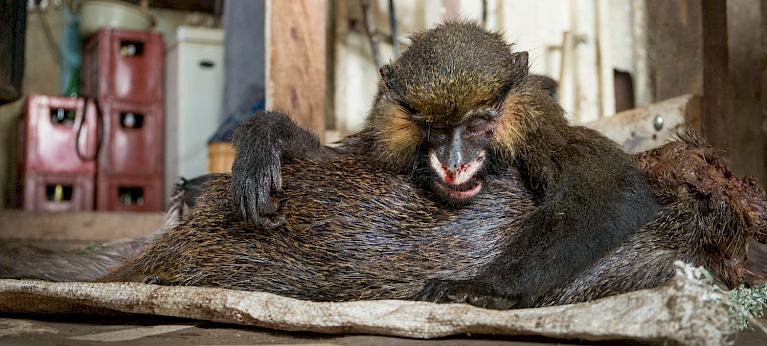
It’s one of the most difficult topics in conservation—and one of the most important to face honestly: the bushmeat trade.
Across tropical regions, particularly in Central Africa, the hunting of wild animals for food is a long-standing practice. For many rural communities, bushmeat isn’t a luxury—it’s a primary source of protein. In forests where livestock is difficult to raise and markets are far away, hunting has always been part of survival.
But over the past few decades, something has changed.
What was once largely subsistence-based has, in many areas, become commercialized. Improved roads, access to firearms, and growing urban demand have turned bushmeat into a trade that reaches far beyond local villages. And primates—especially species like chimpanzee, gorilla, and various monkeys—are among those affected.
The impact is severe. Primates tend to reproduce slowly, with long gestation periods and extended parental care. That means populations can’t quickly recover from hunting pressure. In some regions, this has led to what scientists call “empty forests”—habitats that appear intact but are eerily quiet, missing many of their large animals.
And yet, this is not a simple story of right and wrong.
Poverty, lack of alternatives, and food insecurity all play a role. Blaming local communities ignores the broader systems that drive the trade, including demand from urban centers and weak enforcement of wildlife laws.
There has been progress.
Conservation efforts are increasingly focused on collaboration rather than punishment. Community-led programs are helping to develop alternative livelihoods, from sustainable agriculture to ecotourism. Education campaigns are raising awareness about the ecological importance of primates. In some areas, stricter protections and better enforcement have reduced hunting of endangered species.
It’s not a solved problem. Far from it.
But there is a growing recognition that lasting solutions must support both people and wildlife. Protecting primates isn’t just about stopping hunting—it’s about creating conditions where hunting is no longer the only viable option.
The bushmeat trade is a sobering reminder of how complex conservation can be. But it also shows where hope lies: in understanding, in cooperation, and in the slow, steady work of building better alternatives.
Leave a Reply